Call Professional Mentor

Author

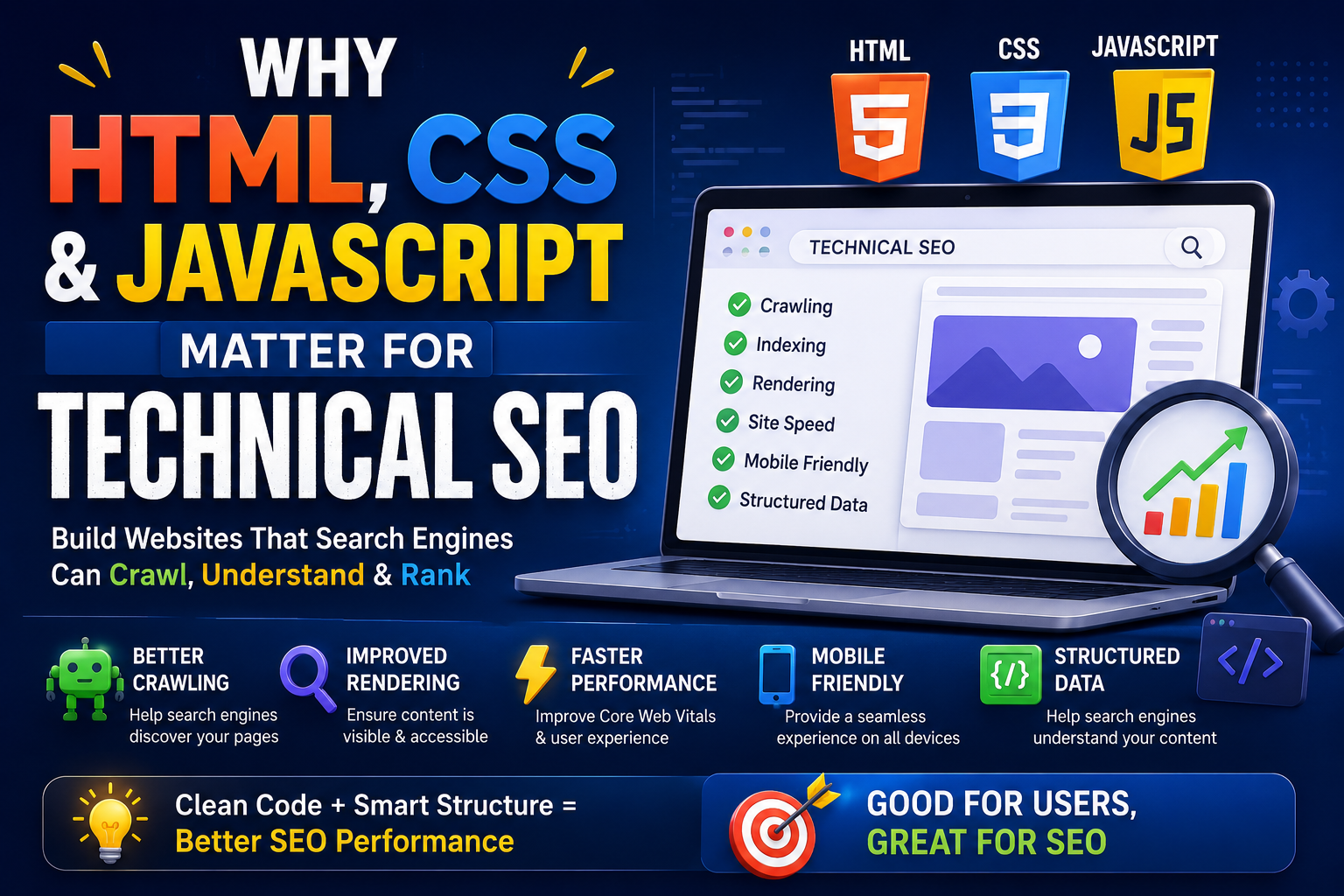
Technical SEO is often associated with crawling, indexing, XML sitemaps, robots.txt, structured data and website speed. However, the technologies used to build a website—HTML, CSS and JavaScript—also play an important role in how search engines understand, render and evaluate web pages.
For beginners, understanding the relationship between HTML, CSS, JavaScript and technical SEO is essential for building websites that are both user-friendly and search-engine friendly.
What Is Technical SEO?
Technical SEO focuses on improving the technical aspects of a website so search engines can crawl, render, understand and index its content effectively.
A technically optimized website should have:
- Clean and understandable HTML
- Mobile-friendly design
- Fast loading performance
- Proper internal linking
- Crawlable content
- Optimized JavaScript
- Good Core Web Vitals
- Structured data where appropriate
- Secure HTTPS
- Search-engine-friendly URLs
HTML, CSS and JavaScript contribute to several of these areas.
1. Why HTML Matters for Technical SEO
HTML (HyperText Markup Language) provides the structure of a web page. Search engines use the HTML document to understand important information such as headings, paragraphs, links, images and page relationships.
Using semantic HTML can make your content easier to understand.
For example:
<h1>Why HTML, CSS & JavaScript Matter for Technical SEO</h1>

<p>HTML provides the structure of a webpage...</p>

<h2>Why HTML Matters</h2>

<p>Semantic HTML helps organize content...</p>
A page should generally have a clear primary heading and logical subheadings.
HTML is also important for title tags and meta descriptions:
<title>HTML CSS JavaScript for Technical SEO</title>

<meta name="description"
content="Learn how HTML, CSS and JavaScript affect technical SEO.">
Well-structured HTML helps establish the page’s content hierarchy and provides important signals about the page.
2. HTML Links and Internal Linking
Links are another important part of technical SEO. Learn Tech SEO in LAMKA With George simte
Search engines can discover pages through crawlable links. For example:
<a href="/technical-seo-guide">
Technical SEO Guide
</a>
Using descriptive anchor text can help users understand where a link leads.
Internal linking can also help search engines discover related content and understand relationships between pages.
Avoid creating important navigation entirely through elements that search engines may struggle to interpret or interact with.
3. Why CSS Matters for Technical SEO
CSS (Cascading Style Sheets) controls the visual presentation of a website, including colors, fonts, spacing, layouts and responsive design.
CSS itself is not primarily an SEO ranking factor, but poor CSS implementation can create SEO and user-experience problems.
For example, excessive CSS can contribute to unnecessary page weight and slower loading. Large stylesheets and unused CSS may increase the amount of resources browsers need to process.
Responsive CSS is also extremely important.
A website should work properly across:
- Smartphones
- Tablets
- Laptops
- Desktop computers
Google uses mobile-first indexing, so mobile usability should be treated as a core part of technical SEO.
4. JavaScript and SEO
JavaScript makes websites interactive and dynamic. It is commonly used for menus, filters, forms, animations, product pages and web applications.
However, JavaScript can create SEO challenges when important content or links are only available after JavaScript executes.
Search engines need to crawl, render and understand web content. If important content isn’t available in a way that search engines can reliably process, indexing may become more complicated.
For example, a website that loads its primary article content only after a JavaScript request should be carefully tested to make sure search engines can access the content.
5. JavaScript Performance Matters
JavaScript can also affect website performance.
Large JavaScript files, unnecessary scripts and excessive third-party code can increase processing time and negatively affect the user experience.
Technical SEO specialists should therefore consider:
- Minifying JavaScript
- Removing unnecessary scripts
- Deferring non-critical JavaScript
- Reducing third-party scripts
- Loading important resources efficiently
- Monitoring Core Web Vitals
The objective isn’t simply to remove JavaScript. Instead, developers should use JavaScript efficiently while ensuring important content remains accessible.
6. HTML, CSS and Core Web Vitals
Technical SEO and website performance are closely connected.
Core Web Vitals focus on important aspects of page experience, including loading performance, responsiveness and visual stability.
HTML determines page structure, CSS controls layout and JavaScript can significantly influence browser processing and interaction.
For example, poorly optimized CSS can contribute to layout shifts, while heavy JavaScript can delay interaction.
Therefore, developers and SEO professionals should work together when optimizing website performance.
7. Technical SEO Requires Developers and SEO Professionals
Modern SEO isn’t just about keywords.
A successful website requires cooperation between SEO specialists, developers, designers and content creators.
SEO professionals should understand enough HTML, CSS and JavaScript to identify technical problems, communicate with developers and perform effective audits.
Developers don’t necessarily need to become SEO experts, but understanding crawlability, indexing, semantic HTML, performance and structured content can help them build search-friendly websites.
8. Schema Markup: Connecting HTML With Search Engine Understanding
Schema markup is structured data added to a webpage to help search engines better understand the meaning and context of the content. It uses vocabulary from Schema.org and is commonly implemented using JSON-LD.
For example, if you’re publishing a blog post about technical SEO, you can use Article schema:
<scripttype="application/ld+json">{"@context": "https://schema.org","@type": "Article","headline": "Why HTML, CSS & JavaScript Matter for Technical SEO","description": "Learn how HTML, CSS and JavaScript affect technical SEO, including crawling, rendering, performance and user experience.","author": {"@type": "Person","name": "George Simte" },"publisher": {"@type": "Organization","name": "Ad Campaign Academy" },"mainEntityOfPage": {"@type": "WebPage","@id": "https://academy.adcampaign.in/" }}</script>
FAQ Schema Example
If your article contains frequently asked questions, you can use FAQPage structured data:
<scripttype="application/ld+json">{"@context": "https://schema.org","@type": "FAQPage","mainEntity": [ {"@type": "Question","name": "Why is HTML important for technical SEO?","acceptedAnswer": {"@type": "Answer","text": "HTML provides the structure of a webpage and helps search engines understand headings, content, links and other page elements." } }, {"@type": "Question","name": "Does JavaScript affect SEO?","acceptedAnswer": {"@type": "Answer","text": "Yes. JavaScript can affect crawling, rendering, content accessibility and website performance when it is not implemented properly." } } ]}</script>
Local Business Schema Example
For a local digital marketing academy, LocalBusiness or a more specific business subtype can describe the organization and location:
<scripttype="application/ld+json">{"@context": "https://schema.org","@type": "EducationalOrganization","name": "Ad Campaign Academy","url": "https://academy.adcampaign.in/","telephone": "+91-8119991197","description": "Digital marketing and e-commerce training academy in Lamka, Churachandpur, Manipur.","address": {"@type": "PostalAddress","addressLocality": "Churachandpur","addressRegion": "Manipur","addressCountry": "IN" }}</script>
Why Schema Markup Is Important
Schema markup does not guarantee higher Google rankings or rich results, but it can help search engines interpret your content more accurately. Depending on the schema type and Google’s eligibility requirements, structured data may also make a page eligible for certain enhanced search-result features.
For technical SEO, always ensure that your structured data accurately represents the visible content on the page and follows Google’s current structured-data guidelines.
Conclusion
HTML, CSS and JavaScript matter for technical SEO because they influence how websites are structured, presented, rendered and experienced by users and search engines.
HTML provides the foundation and content structure. CSS creates responsive and accessible layouts. JavaScript adds functionality but must be implemented carefully so important content remains accessible and performance stays strong.
If you’re learning technical SEO, don’t focus only on keywords and backlinks. Learn the basics of HTML, CSS and JavaScript, understand how browsers and search engines process webpages, and regularly test your website’s crawlability, rendering, mobile usability and performance.
These skills can give beginners a strong foundation for becoming a more effective technical SEO specialist or web developer.
- Why HTML, CSS & JavaScript Matter for Technical SEO
- Google Digital Marketing & E-commerce Course in Lamka, Manipur
- Best SEO Training Course in Lamka, Manipur
- How to Choose the Right Digital Marketing Academy: A Complete Guide
- Best Digital Marketing Institute in Lamka – Job Ready Course