Call Professional Mentor

Author

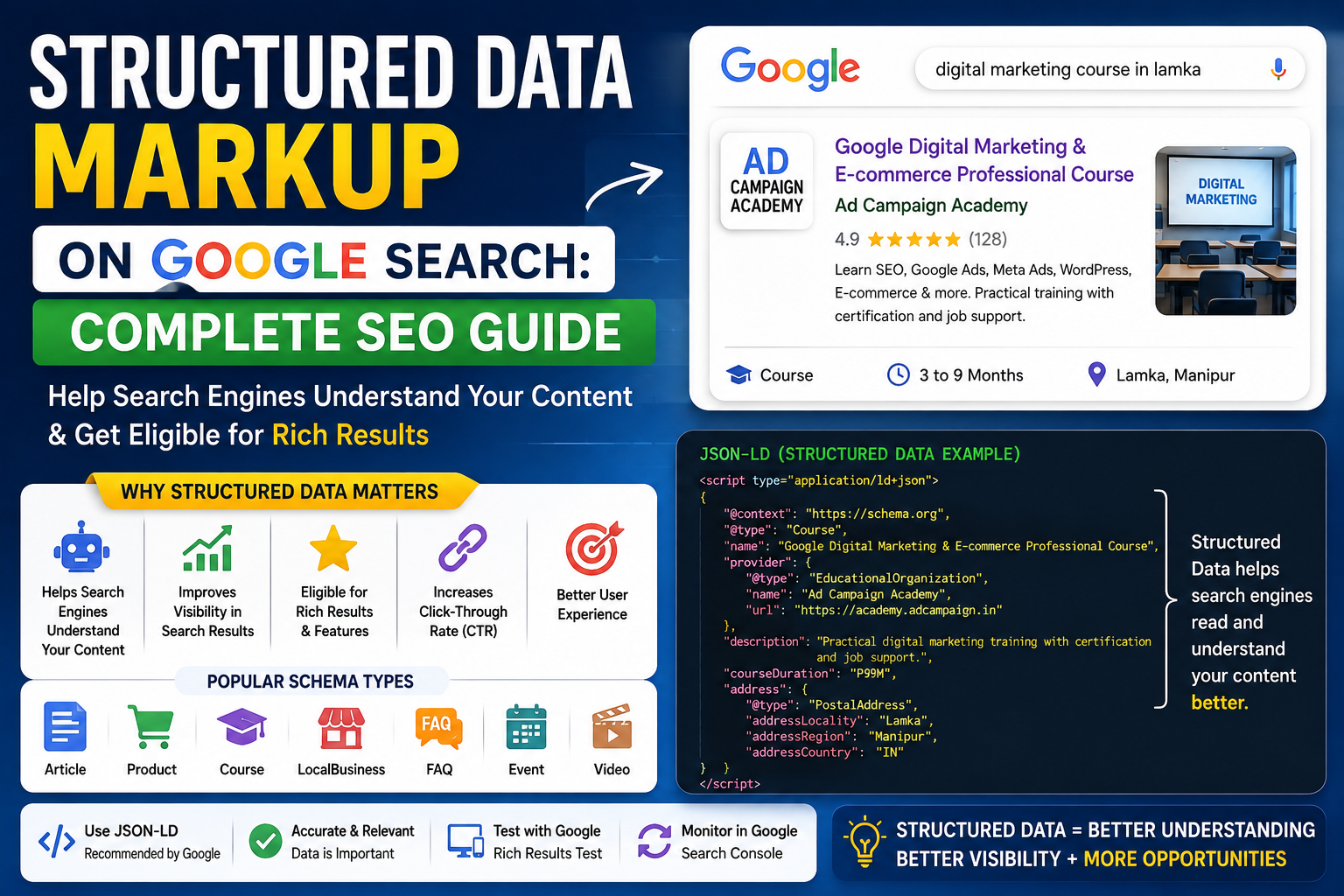
Structured data markup is an important part of modern technical SEO. It helps search engines understand what a webpage is about and identify important entities such as articles, products, organizations, courses, events, recipes and frequently asked questions.
Structured data does not guarantee higher Google rankings, but correctly implemented structured data can make eligible pages suitable for certain enhanced search features and rich results.
In this guide, you’ll learn what structured data is, how it works, common schema types, implementation examples and important SEO best practices.
What Is Structured Data Markup?
Structured data is a standardized format that provides search engines with additional information about the content of a webpage.
For example, a normal webpage might contain:
Ad Campaign Academy offers a digital marketing course in Lamka.
Structured data can help communicate that the page represents an educational organization and a course.
One of the most common ways to implement structured data is JSON-LD, which is placed inside a <script> element.
Why Is Structured Data Important for SEO?
Structured data can help search engines better understand the meaning and context of your content.
It can be particularly useful for:
- Articles
- Products
- Organizations
- Local businesses
- Courses
- Events
- Recipes
- Videos
- Breadcrumbs
- Software applications
- Reviews where eligible
- Frequently asked questions where eligible
Google can use eligible structured data to enhance search appearances. However, structured data is not a direct ranking guarantee. Are you content creator, business, students Learn SEO Google Ads In Lamka
The most important principle is accuracy: the markup should describe content that is actually present on the webpage.
JSON-LD Example
Here is a simple Article structured data example:
<script type="application/ld+json">
{
  "@context": "https://schema.org",
  "@type": "Article",
  "headline": "Structured Data Markup on Google Search",
  "description": "A complete beginner's guide to structured data markup and SEO.",
  "author": {
    "@type": "Person",
    "name": "George Simte"
  },
  "publisher": {
    "@type": "Organization",
    "name": "Ad Campaign Academy"
  }
}
</script>
The @context tells search engines which vocabulary is being used, while @type identifies the type of entity being described.
Organization Schema Example
Businesses and organizations can provide information about their identity using structured data.
For example:
<script type="application/ld+json">
{
  "@context": "https://schema.org",
  "@type": "EducationalOrganization",
  "name": "Ad Campaign Academy",
  "url": "https://academy.adcampaign.in/",
  "telephone": "+91-8119991197",
  "address": {
    "@type": "PostalAddress",
    "addressLocality": "Churachandpur",
    "addressRegion": "Manipur",
    "addressCountry": "IN"
  }
}
</script>
This communicates information about the organization in a structured format.
Always make sure the information in your markup matches the information presented on your actual website.
Course Schema Example
Educational websites can use Course structured data to describe courses.
<script type="application/ld+json">
{
  "@context": "https://schema.org",
  "@type": "Course",
  "name": "Google Digital Marketing & E-commerce Professional Course",
  "description": "Professional digital marketing and e-commerce training covering SEO, Google Ads, Meta Ads, WordPress and e-commerce.",
  "provider": {
    "@type": "EducationalOrganization",
    "name": "Ad Campaign Academy",
    "url": "https://academy.adcampaign.in/"
  }
}
</script>
Course structured data can help search engines understand that the page represents an educational course rather than a general blog article.
Breadcrumb Schema Example
Breadcrumbs help communicate a webpage’s position within a site’s hierarchy.
For example:
Home → SEO → Technical SEO → Structured Data
You can represent this using BreadcrumbList:
<script type="application/ld+json">
{
  "@context": "https://schema.org",
  "@type": "BreadcrumbList",
  "itemListElement": [
    {
      "@type": "ListItem",
      "position": 1,
      "name": "Home",
      "item": "https://example.com/"
    },
    {
      "@type": "ListItem",
      "position": 2,
      "name": "SEO",
      "item": "https://example.com/seo/"
    },
    {
      "@type": "ListItem",
      "position": 3,
      "name": "Structured Data",
      "item": "https://example.com/seo/structured-data/"
    }
  ]
}
</script>
This can help search engines understand the site’s content hierarchy.
FAQ Structured Data Example
FAQ structured data describes questions and answers that appear on a webpage.
<script type="application/ld+json">
{
  "@context": "https://schema.org",
  "@type": "FAQPage",
  "mainEntity": [
    {
      "@type": "Question",
      "name": "What is structured data?",
      "acceptedAnswer": {
        "@type": "Answer",
        "text": "Structured data is a standardized format that helps search engines understand the content and meaning of a webpage."
      }
    },
    {
      "@type": "Question",
      "name": "Does structured data improve rankings?",
      "acceptedAnswer": {
        "@type": "Answer",
        "text": "Structured data does not guarantee higher rankings, but eligible markup can help pages qualify for certain enhanced search features."
      }
    }
  ]
}
</script>
Important: Google has specific eligibility and display requirements for rich results, and FAQ rich results are currently limited to certain authoritative government and health sites. Therefore, don’t add FAQ markup solely because you expect an FAQ rich result.
Structured Data Best Practices
Follow these important SEO practices when implementing schema markup:
1. Use Accurate Information
Never add information to structured data that isn’t supported by the visible page content.
2. Choose the Correct Schema Type
Don’t use Product schema for an article or Article schema for a course. Select the type that accurately represents your content.
3. Don’t Add Fake Reviews
Review and rating markup must represent legitimate content and follow Google’s guidelines.
4. Use JSON-LD
JSON-LD is generally the easiest structured-data format to implement and maintain.
5. Validate Your Markup
After implementation, test your structured data with Google’s available testing and validation tools and monitor your pages in Search Console.
6. Keep Content and Markup Consistent
If your webpage says one course price but your structured data contains another price, you have a data consistency problem.
Structured Data vs SEO Ranking
It’s important to understand that structured data is not a magic ranking technique.
Adding Schema.org markup doesn’t automatically move a webpage from page 10 to page 1.
Strong SEO still requires:
- Helpful and original content
- Search intent optimization
- Good technical SEO
- Fast and accessible pages
- Mobile-friendly design
- Internal linking
- Quality backlinks where appropriate
- Strong website architecture
- Good user experience
Structured data works alongside these SEO fundamentals by providing additional machine-readable context.
Final Thoughts
Structured data markup is an important technical SEO technique for helping search engines understand webpages and entities. JSON-LD makes implementation relatively straightforward, whether you’re marking up an article, course, organization, breadcrumb trail or another supported content type.
For beginners, start with the schema type that accurately describes your page, make sure the information is visible and truthful, validate your implementation, and monitor your site’s search performance.
Remember: structured data can help search engines understand your content, but useful content and a technically strong website remain the foundation of successful SEO.
Structured Data Markup on Google Search: Complete SEO Guide With Examples
Structured data markup is an important part of modern technical SEO. It helps search engines…

Ad Campaign Academy Admission Open for 10 Days – Get ₹10,000 Off + 4 Months EMI
🚀 Hurry! Admissions Are Open for a Limited Time Are you looking to build a…
Why HTML, CSS & JavaScript Matter for Technical SEO
Technical SEO is often associated with crawling, indexing, XML sitemaps, robots.txt, structured data and website…

Google Digital Marketing & E-commerce Course in Lamka, Manipur
Digital marketing has become one of the fastest-growing career fields, creating opportunities for students, graduates,…

Best SEO Training Course in Lamka, Manipur
Search Engine Optimization (SEO) is one of the most valuable digital skills in today’s online…

How to Choose the Right Digital Marketing Academy: A Complete Guide
By Ad Campaign Academy, Lamka Digital marketing has become one of the most in-demand skills…